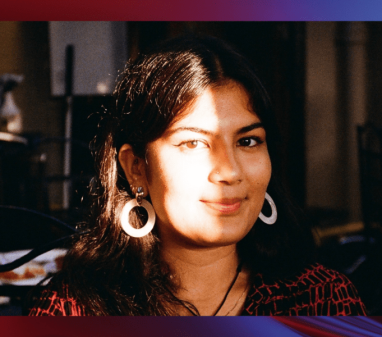
This year’s Race Across the World saw five pairs travel on an extraordinary journey from the Great Wall of China down into India. Among them, one pair in particular stood out: formerly married Yin and Gaz, whose poignant story of enduring friendship and support captured audience hearts. Yin joined Asma for a candid conversation about growing up as a British-born Chinese person, reconnecting with cultural identity, and forging one’s own ideas of belonging.
Asma: In Race Across the World (Race) you briefly mentioned your experiences growing up in the UK as someone with Chinese heritage – as a child, did you see much Chinese representation on TV or in films?
Yin: The only program that had some Chinese representation was a programme called the Chinese Detective, with an actor called David Yip. That’s going back a long time. The only other person I can think of is the Chef Ken Hom, who popularised Chinese cooking.
There definitely weren’t any Chinese woman to look up to or feel a presence of, other than within our own community. But even in our community, we spoke a dialect called Hakka. I can understand Cantonese but I don’t speak it, or Mandarin. On Race, it was difficult because while I appeared ‘Chinese’ I definitely felt like an outsider. It’s a really strange situation because although I grew up looking Chinese, I don’t know very much about my own culture and history, as I went to school here so I learnt about English history.
Asma: Were you born in the UK?
Yin: Yes, I was born in Kent. I didn’t come with my parents from Hong Kong. They didn’t speak English very well, and when we were younger they used us children as interpreters for them, which is quite a familiar experience for any child with an ethnic background of that era. When I speak to friends from a different ethnic backgrounds, we all had similar stories of going to the bank and like shops with mum and dad to interpret for them.
Asma: That seems to be a fairly universal first or second generation immigrant experience. Did your area have a quite few people from Chinese descent , or from different ethnic backgrounds?
Yin: At school, there was myself, a Turkish girl, and a Greek Cypriot girl – I went to an all girls school. Later one I think there was another Chinese girl but she was in one years below me.
One of my friends was a Nigerian girl, and we’d often meet up in the town centre. If we were stood together, people would stare and comment on us, but it was quite funny at the time to see two people of different ethnic backgrounds next to each other, which is now a bizarre thing to say.
I was a child during the 70s, when the National Front were quite prevalent, and in a white suburban town where there weren’t many other people of different backgrounds. The school I went to had probably five other people from different ethnic heritages.
I never really feel as home anywhere, so I don’t feel like I’m fully accepted as a British person because of my appearance but when I go to China or Hong Kong, I don’t feel like I’m accepted there either. When I’m asked ‘Where do you feel at home?’ I don’t actually think I could answer. I think once I retire I might leave this country because there’s nothing that holds me.
The 90s is when I felt there was a cultural shift to a wider acceptance of different ethnicities but now is probably the first time I’m feeling a slight unease again because of the political rhetoric, especially with the Operation Raise the Flag. 20 years ago in the 90s, it would’ve weakened, but if you grew up in the 70s with the National Front movements, the flags have a very specific connotation. It doesn’t stop me from going out but you can feel like that underlying worry.
Asma: Before going on Race, did you have any moments of wanting to reconnect with your Chinese heritage, and how?
Yin: Both my parents passed away, well over a decade ago now. Once they passed, I didn’t really have any need to speak Chinese. I’ve got three other siblings, but we generally use English to talk to each other, and we drop in a couple of Hakka words. It’s true that if you don’t use it, you lose it. When I see my sister, I do try to use Hakka or Cantonese with her mother-in-law, but it’s a struggle to find the right words sometimes.
I’m not really interested in relearning the language, but my connection to being Chinese is through food. The fond, positive memories I have growing up are all related to food, home cooking, certain dishes. When I crave those dishes I have to think about how I’ll replicate them, so even though my parents have passed, I can still remember their cooking. When I had my own daughter it pushed me to think about getting the recipes down
I do cook a lot of homestyle Chinese food similar to that of my childhood. Through asking my sister and trying the dishes out on her, or asking at restaurants, I’ve managed to figure out what the ingredients are and how to make the same flavours.
Asma: I think when moving country or culture, food is such a tangible way to remain connected to your roots, to remind you of home or of a certain time in your life.
Yin: The best thing about Race was the food. We were limited by budget but when we stayed at home-stays, the food was amazing. I recognised everything and it felt like having dinner back at home with my mum and dad when they were alive.
When we were in Shanghai, all the street food were things that I recognised, and the flavours were all familiar.
I suppose one of the disappointing things about going out so quickly on Race was that we didn’t get to experience a different culture, which was one of the reasons I wanted to do it. China definitely did show me some new things but I wish I’d gone to India first. That being said, food often ends up being a big challenge on Race, but for me it wasn’t! Every time we got home cooking, I thought, bring it on, I’ll have seconds, thirds!
Asma: I saw a clip of the Race reunion where you mention your struggle with your identity, and how going on Race helped you reconsider it and speak with your siblings on your shared experiences. In what ways do you think Race helped you change the way you think about your dual identity?
Yin: I’ve always felt challenged growing up being British born Chinese and trying to immerse myself in British culture. As a child, all you want is to be accepted by your peers. I felt like the odd one out, then at home I felt frustrated because my peers were able to do things accepted in ‘their’ culture which wasn’t in my family’s.
My parents weren’t surrounded by people they had grown up with, and they didn’t have the security of knowing the language to be able to understand or accept the difference in lifestyle or beliefs. Home felt quite restrictive. Growing up, it was a balance between wanting to be accepted at school, but at home I wasn’t allowed to do the things that would allow me to be accepted.
It was a constant tightrope of pleasing parents but wanting to be accepted by my peers. I’m sure you’ve probably experienced that growing up, it’s not unusual for anyone who has a different ethnic background to the country they’re in; I’d likely have the same experience in Spain, for example.
When I left home, I threw myself more into being British than Chinese. I didn’t necessarily abandon my Chinese heritage, but once I left home I felt I didn’t have to follow the Chinese traditions, I can do what I want, like go out and see a band, or go clubbing, or whatever. The door to retaining or acknowledging my Chinese heritage was slowly closing in some ways, because my parents weren’t able to tell me what to do anymore.
Going back to China after I had moved on and forged my own life and career did bring back feelings of being a child again growing up in a strict Chinese household. It did force me to think about my feelings towards my childhood again, so I spoke to my sister and younger brother about it. We shared many of those experiences in common, and realised they weren’t isolated to just one of us, which gave us an opportunity to reconnect in a way.
In some ways, I feel much calmer about my experiences growing up and it’s afforded me to look at the Chinese heritage in a more balanced way. For me, I can choose what I want to take away from it. I do have an interest in certain aspects of Chinese culture, but I wouldn’t say that I’d dash back to China anytime soon. Everyone has their individual experiences growing up with a dual identity – it’s not to say that I’m dismissive of my heritage and culture but I can face it with more peace, choose what I want to take from it to pass onto my daughter.
Asma: As I have grown older, I’ve been able to connect with my own heritage too and forge my own understanding of it, and feeling pride in it. Is there anything, when you were younger to now, that you feel pride in of being Chinese?
Yin: One of the things is definitely the food but there are other things about Chinese culture, such as the art and dress that I find really pleasing. As a teenage we used to watch Chinese soap operas and listen to Chinese pop music which was always entertaining and make me smile when I look back on it.
When we were on Race, when we had downtime in between the race legs Gaz and I would watch a few Chinese dramas. What was interesting about it is that one of the Chinese period dramas was about the opium trade wars, they portrayed the Westerners as the antagonists, but if it was produced by an English company they would’ve flipped it. It was interesting seeing both sides of it, having grown up Chinese in Britain. Gaz found the history of it all really fascinating too, like how Hong Kong was leased to Britain and the history before the Cultural Revolution, he’d said ‘why don’t we learn about this at school?’ But in school we focussed more on the monarchy and things within the British Isles. I think having a dual identity or heritage does help in being a much more open person to other culture, because you realise how world history is very much interlinked.
Asma: In school we did learn a bit about the partition of India and Pakistan, but it is difficult to cover all the places Britain had impacted. My parents hardly know anything about how it affected their families, or at least the stories weren’t passed down to them.
Yin: I remember asking my parents. My mum was really young when the Cultural Revolution happened. She had a photo of her parents, which was quite rare because they were so expensive. They were adorned in luxury garments. I don’t know what happened to her parents, but from piecing together what my mum told me, she was taken away to be raised by her grandmother in the countryside and she never saw her parents again.
I must admit, our relationship was quite strained but, as I said, we’re all a product of our experiences. She was born in a well-to-do family, had an arranged marriage with my dad and emigrated across the world in the search of a better life. I’m sure it’s not a dissimilar story to you and a lot of people, of looking for other opportunities.
Asma: To end, while there is a feeling of confusion in understanding where you ‘belong’ when you have a dual identity, I think British Asians have created a new hybrid identity for ourselves
Yin: I do feel that, too. It’s really nice speaking to British born people of different ethnic origins and finding similarities. There is a real connection there that you can’t find anywhere else, I think, and in a way gives a sense of belonging.