
At the 68th BFI London Film Festival on 11th October, the internationally acclaimed Malaysian director Tsai Ming-liang will return with his tenth episode in his Walker series, featuring both protagonists from Days: the magnificent Lee Kang-sheng and singular Anong Houngheuangsy.
Abiding Nowhere (2024)
Director: Tsai Ming-liang
With Lee Kang-Sheng, Anong Houngheuangsy
Taiwan/USA | 2024 | 79min
Courtesy of Homegreen Films
At the 68th BFI London Film Festival, we had the privilege of talking to director Tsai Ming-liang for an exclusive interview, where he shared the stories and insights behind his latest film, Abiding Nowhere.
Abiding Nowhere is set in the United States. Why did you choose the U.S. as the location for this film?
TSAI: I was invited actually. As long as there are the opportunities and fundings, I will go to different places, different cities to shoot my films. My work is very simple, it’s just Lee Kang-sheng moving very slowly with his body. Many invitations including film festivals, art galleries, even commercial advertisements and TV broadcasters come to me. As long as there is enough funding, I will go and shoot “Walker”.
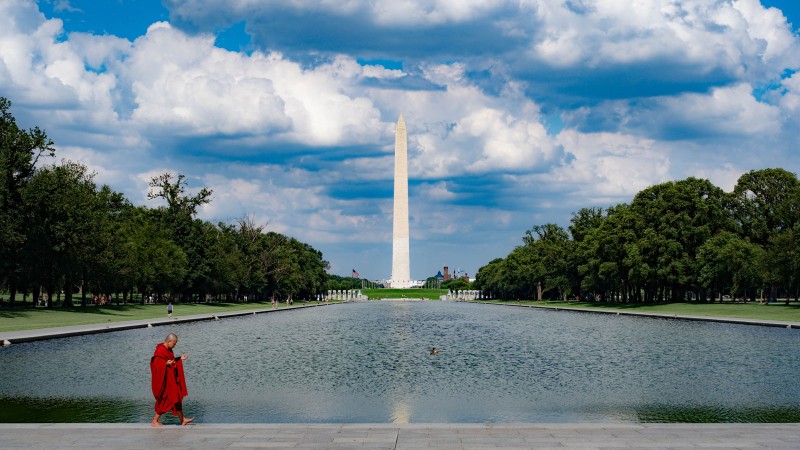
This series has been going on for the past ten years. Going to Washington is also an invitation that an Asian art gallery offered me. And of course they want me to go to Washington to shoot the film. That’s why they invited me. So I went to Washington DC,this place is relatively unfamiliar to me. There are very few chances for me to go to the States to shoot, this is my first time.
Can you share what kind of preparation went into location scouting for this film? How long did it take?
TSAI: I’ve been to Washington twice. The first time was a few years ago. There were several cities on the east coast that invited me to give a speech, so I just happened to be there. And then I went again before the shoot, to take a closer look and get to know the city. I think Washington gives out a certain vibe. The city often appears in American movies, so we all know more or less of it. Washington has the White House,the Pentagon, there is the Washington Monument, these images are familiar to us. But I’d like to see the other side of Washington, to see its ordinary people and their daily life. So the spaces I chose to shoot later were not the ordinary Washington we see in movies.
The residents of Washington’s attitude towards me shooting “Walker” are different. They might already be used to a film set so nobody cares about me. You can see the people on the street are all quite indifferent. Unlike shooting in Paris. There are so many tourists in Paris, and they are very interested in the movie set.
Especially with Lee’s special pose during the shoot, people will pay attention to it and stop to look back.
Each film of the “Walker” series happened in a different place,the atmosphere of the shoot was different. Washington is pretty special I think. It’s a very comfortable and chill place. I shot this film in a very relaxed state of mind
This is the third time you’ve worked with Anong. After three collaborations, has your way of working with him changed? Will you be working with him in the future?
TSAI: Anong and I met in 2016, it has been many years. I asked him to be in one of my feature films called Days. He is from Laos and was working in Thailand as a laborer before I met him. After filming that movie, I think it’s a bit of a pity to see him going back to his previous life.So I asked him if he would like to work with me and he said yes. He’s been with me for years now. He works as an assistant by my side. Now, I will ask him to join my works in art galleries or films.
In your previous works, you arranged for an encounter between Lee Kang-sheng’s character and Anong’s character. In Abiding Nowhere, Anong’s character seems to exist parallel with Lee’s. What was the intention behind this? Did you ever consider having them meet?
TSAI: Anong participated in my “Walker” series as well. It’s the second one he worked with me. My ninth film of “Walker” is called Where and I invited him to participate in this film. In the film, there’s a point of intersection for the two of them. For this time, I want to shoot Anong again.
But I made the two protagonists to be parallel in this because I just want to depict the status of all living beings.
The concept of “Walker” is Lee Kang-sheng walking through many cities, many countries, and a lot of space, to see the world at a slower pace. The context is very simple but also gives a lot of free space to create. Not only for Anong, I also invited other actors to be in other parts of the “Walker”.
Perhaps I’m overthinking it. In Walker, which was shot in Hong Kong, Lee Kang-sheng’s head is bowed so low that initially, I thought he looked more like a beggar instead of a monk. However, in Abiding Nowhere, Lee’s posture is noticeably different, with his head held higher. Was this a deliberate adjustment?
TSAI: Well, among the 10 films in “Walker”. Each one is a little bit different. I basically have no restrictions on how Lee will walk. My only demand is for him to be slow. He will decide if his head should be lower or higher. When Lee Kang-sheng was shooting in Hong Kong, his neck was feeling very uncomfortable. So his head will be pressed lower. The filming is different every time, I will let Lee play his role without constraint.
Lee Kang-sheng has played many roles named “Hsiao Kang” in your films. He said that his favourite of all the “Hsiao Kang” is from Rebels of the Neon God. Which “Hsiao Kang” is your favourite?
TSAI: I like every one of them. Because every stage of him is different. Hsiao Kang started to be in my movies at the age of 20 and he is over 50 now. I feel that at every stage of his life, he is very at ease in my films. Compared to how he works in other films with other directors. Others may require him to create a character. But I prefer to shoot the part of Kang-sheng himself. I’m filming him at every age, in different stages, different appearances. So every time the film comes out, the feeling it gives you will be very natural, very authentic.

I loved how you used Sam Hui’s music at the end of Walker, and the music at the end of Abiding Nowhere also gave me a sense of enlightenment. Could you talk more about this piece of music and why you pick it?
TSAI: In my films, I like to choose the music I like, the music I usually listen to. The music for Abiding Nowhere is a piece of Tibetan music I like a lot. This song is sung by the tantra monks. This CD has been with me for about a decade or two. When I was making Abiding Nowhere, this melody popped into my head for no reason. So I used it. I loved the ending with this music piece very much.
You often explore the relationship between people and space in your films. We see Lee Kang-sheng walking through different places. In your earlier works like Rebels of the Neon God, we see him riding a motorbike through the streets of Taipei. Is this a topic you intentionally like to explore?
TSAI: Every film of mine has different focuses and emphasis. It has something to do with my age. At a certain age, the films I want to make have to have more freedom in it. I don’t want to be
restricted by the idea of cinema that we are used to. So I decided to shoot this long series of “Walker” as an expression. Instead of just a feature film, I hope the audience can see different things and different presentations of creations in the theater. That’s why I made “Walker”.
As far as I know, the “Walker” series was planned to have ten films. Do you plan to continue making them? What new projects are coming up next?
TSAI: Yes, this series will continue to move forward. I received some invitations already. Then I will also work on other projects.
When watching new directors’ works, we often hear comments like “they’re imitating Tsai Ming-Liang”. How do you feel about young directors being compared to you or accused of imitation? Do you think this is a good or a bad thing?
I think movies are meant to influence each other. When I was young, I watched a lot of directors I liked and I really wanted to be like them as well. Making movies is actually a life long learning process. It will also take a long time to walk on this path, then you have to find your own way to learn it.
Of course everyone is influenced by the director they like, I think that’s perfectly normal.
Abiding Nowhere is premiering at the 68th BFI London Film Festival on 11th October at 3.45pm at the BFI Southbank, with a second screening on 14th October at 5.45pm at the ICA.
SCREENING DATES
Friday 11 October 2024 15:45
BFI Southbank, NFT1
Monday 14 October 2024 17:45
ICA, Screen 1
BOOK NOW
Lou Cai is an accredited reviewer and journalist for the 2024 London Film Festival.

