
The unique and vibrant cinema-going culture in the UK has been inspiring Greater China in many ways, we have been tracking its soft power influence and this article focuses on the passion for classics.
The UK’s cinema-going landscape has seen a remarkable resurgence of interest in classic films from around the world, including Chinese cinema. Active venues involved include the ICA, the Prince Charles Cinema, the BFI Southbank, HOME Manchester, and Edinburgh Filmhouse, just to name a few. Restored masterpieces by iconic directors like Wong Kar-wai, Ang Lee, and Tsai Ming-liang have mesmerised audiences, reigniting a passion for timeless cinematic storytelling.
Recent Successes in the UK
The Prince Charles Cinema, one of London’s most iconic independent venues situated near Chinatown, has been instrumental in promoting Chinese classics. Regular screenings of Wong Kar-wai’s celebrated films—such as Chungking Express (1994), Fallen Angels (1997), and In the Mood for Love (2000)—continue to captivate moviegoers. The 4K restoration of In the Mood for Love became a highly popular screening event, cementing the film as a repertory favorite in London and beyond. The cinema’s ongoing efforts were demonstrated in September 2024 with a screening of Tsai Ming-liang’s Goodbye, Dragon Inn (2003), which drew packed audiences, further affirming viewers’ interest in restored classics from the Far East. Wong Kar-wai’s classics have been regularly showing at the Prince Charles Cinema for now over four years, and it’s has become the cinema’s resident programming repertoire.
The BFI has further cemented its support for specialised classic cinema through retrospectives on luminaries like Edward Yang and Hou Hsiao-hsien. Both directors are seminal figures in the Taiwan New Cinema movement, which emerged in the 1980s and is characterised by its realist storytelling, social commentary, and focus on human relationships. In collaboration with Janus Films and Taiwan Film and Audiovisual Institute, the BFI is currently re-releasing a collection of Edward Yang’s films, including Taipei Story (1985), A Brighter Summer Day (1991), and Yi Yi (2000) all in stunning 4K restorations. This April will see the launch of this Taiwan New Cinema season, featuring additional screenings and events.
Focus Hong Kong, a UK film festival dedicated to celebrating Hong Kong cinema, has also played a pivotal role in reintroducing classics at venues like the Garden Cinema. In recent years, they have showcased works by influential Hong Kong New Wave filmmakers such as Ann Hui (Boat People [1982], A Simple Life [2011]), Peter Chan (Comrades, Almost a Love Story [1996]), and Mabel Cheung (Eight Taels of Gold [1989]). These screenings not only highlight the technical and thematic innovations of the New Wave era but also offer overseas audiences a glimpse into the socio-political transformations that shaped Hong Kong during the 1980s and 1990s.
A standout moment in recent years was UK’s re-release of Ang Lee’s Lust, Caution (2007). An Academy Award-winning director and one of the most influential figures in international cinema, Lee is known for his masterful storytelling that transcends cultural boundaries. During Odyssey 2024, our annual film festival’s warm up, we collaborated with Park Circus and Universal UK which broke a sales record for Chinese re-releases in the UK, with 300 seats selling out within 24 hours. Additional screenings quickly followed suit. Lee’s landmark film Crouching Tiger, Hidden Dragon (2000), which won the Academy Award for Best Foreign Language Film and captivated global audiences with its breath-taking martial arts sequences and poetic narrative, is also currently re screening across the UK to celebrate its 25th anniversary, reaffirming his enduring popularity among international audience.
We can quite confidently announce that, the UK is the most active destination to experiment releases and re-releases of of Chinese-language films, including classics, with London being the central hub of the world. Its activeness is something other cities cannot compete and this is what we recognised as part of the UK’s ‘soft power’.
Inspiring a Technological Renaissance in Greater China
The success of classic Chinese film re-releases in the UK has inspired a wave of restoration projects in China, where filmmakers and archivists are embracing advanced technologies to preserve cinematic heritage. Institutions have increasingly invested in 4K, Dolby, IMAX, and CINITY restorations to ensure these works remain visually stunning and accessible to contemporary viewers.
A prime example is Hou Hsiao-hsien’s A City of Sadness (1989), which underwent a 4K digital restoration and was re-released in theatres across Taiwan on February 24, 2023, after 33 years. The film’s re-release was met with overwhelming enthusiasm; during the Beijing International Film Festival in the same year, tickets for the 4K version sold out in just six seconds, breaking previous records.
Jia Zhangke, another prominent figure in contemporary Chinese cinema, has also experienced a resurgence of interest in his earlier works. His film Platform (2000), which explores the cultural and social changes in China during the 1980s, was re-released in China in 2021. The re-release was part of a broader initiative to celebrate Jia’s contributions to Chinese cinema and to introduce his works to new audiences. The event was well-received by both critics and audiences, highlighting the enduring relevance of Jia’s films.
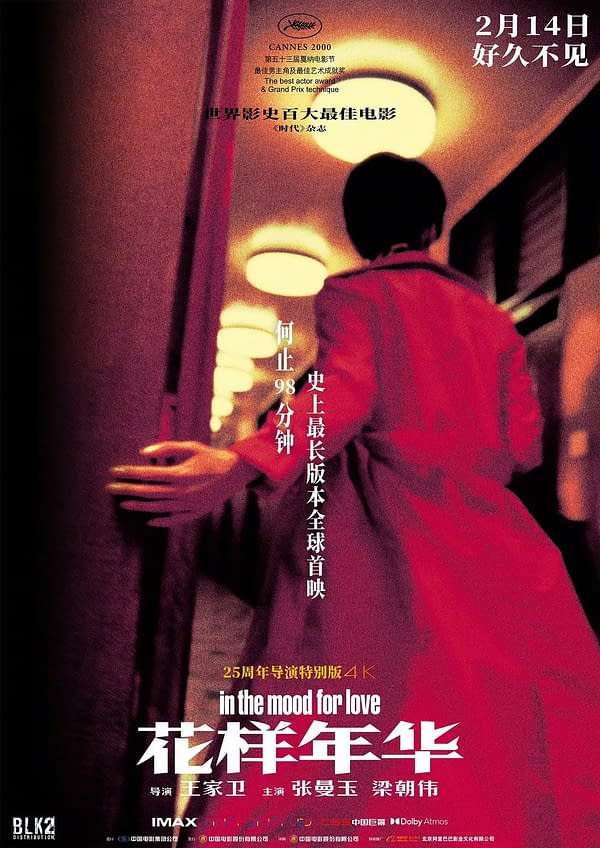
In the Mood For Love (2020) 2025 re-release official poster for mainland China.
Opening New Markets and Future Prospects
The Shanghai International Film Festival has been the most well-known platform to showcase international classics during the festival period, including Chinese classics.
However, UK’s resent successes in reintroducing classic Chinese films underscores the vast potential for similar initiatives in Greater China and beyond. As advancements in restoration technology make cinematic masterpieces more visually captivating, these works are uniquely positioned to engage both nostalgic viewers and younger generations seeking immersive artistic experiences.
This growing interest represents not only a cultural opportunity but also significant financial potential. The successes of restored classics in the UK, with sell-out screenings and widespread critical acclaim, highlights a lucrative market for classic Chinese cinema internationally. It serves as a compelling case for Hong Kong, mainland China and Taiwan’s stakeholders to invest in the business of restoration and international circulation. Wong Kar-wai is only the beginning.
By forming strategic partnerships with international distributors, curating retrospectives, and leveraging local restoration technologies, there are opportunities to be tapped into a burgeoning global audience eager for high-quality restored classics. Such efforts will bring a new economic activities in the region, as piloted in the UK
From the UK, to China and Beyond
In the Mood for Love (2000) is possibly the most screened Hong Kong Chinese classic in the UK via The World of Wong Kar-wai retrospective season (2021) as well as the Prince Charles Cinema’s regular programming thereafter. We also had the only to include it as part of Odyssey 2024 last year. With the recent increasing population of Chinese students in London, they become the most effective advocates to introduce this trend back home via social media platforms such as Red Note. While this is a type of advocacy we started since the inception of the NGO, there are now many more organic advocates involving in the same mission. The ideal worked and thanks to thousands of Chinese students sharing their experience from watching In the Mood for Love‘s 4K restoration on a big screen in London. This timeless classic is now finally set to be re-release in mainland China on Valentine’s Day (Feb 14). This is the first time ever that a Wong Kar-wai film being re-released in the mainland and we think the Prince Charles Cinema deserves the full credit in this truly cross-cultural influence.
Our own initiative of Lust, Caution (2007)’s re-release also generated some inspiration. While a re-release in mainland China is currently impossible (due to its 18+ nature), the re-release baton has been picked up by South Korea in 2025. We wish them the best of luck with their adventure and will help to support via our channels the best we can.
This article has been edited by Sicun Wu and Hiu Man Chan.
Remarks by Founder & Director of NGO UK-China Film Collab, Dr Hiu Man Chan
“I hope we have showed via this article and elsewhere, that UK-China Film Collab exists not only in a bilateral nature, but it’s also multilateral. Our unique and original initiatives inspire not only two countries, but beyond. ”

