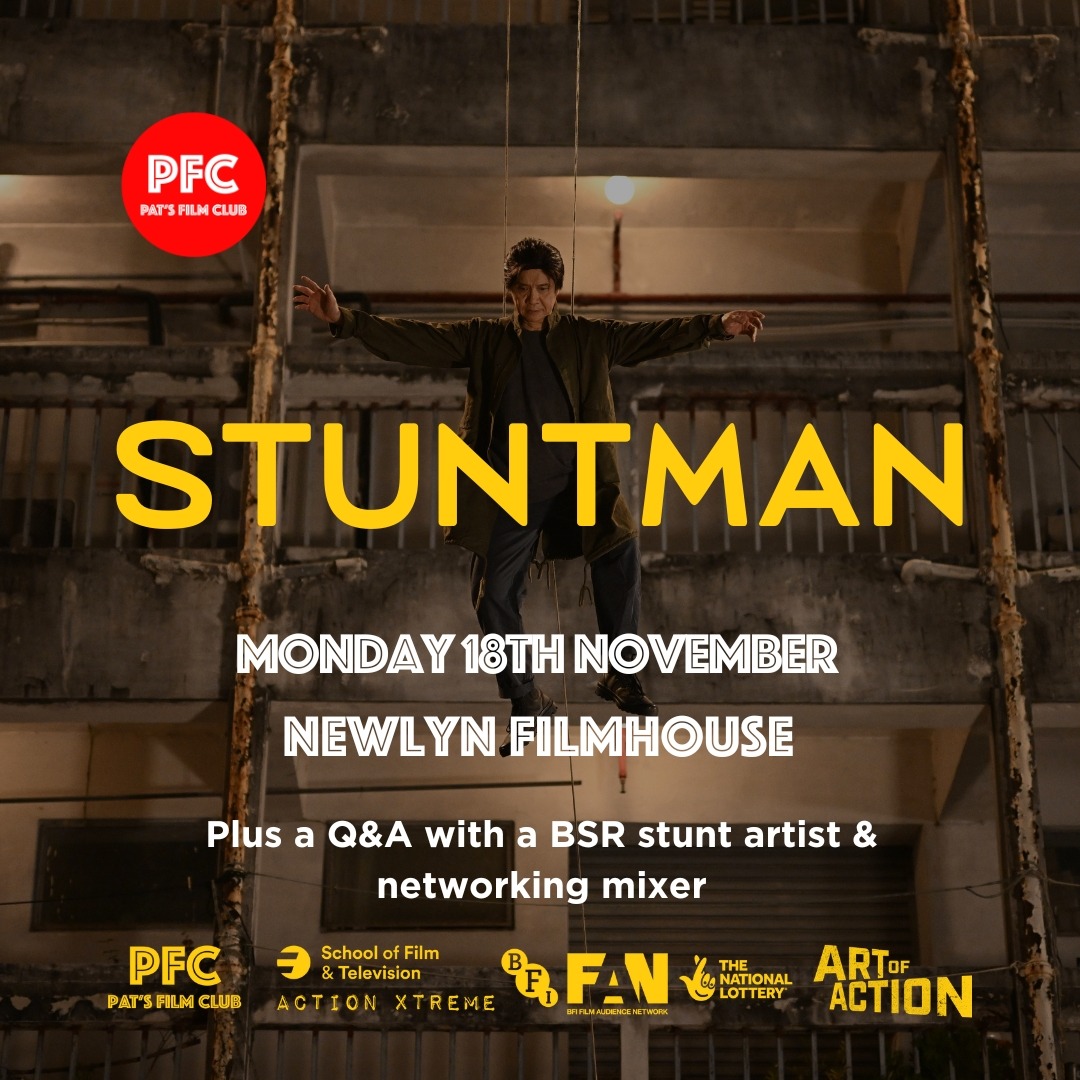
Stuntman is a beautiful homage to Hong Kong action films in the 80s. Currently showing as a part of BFI’s Art of Action season.
★★★★☆ 4/5
There can be little doubt that Stuntman is a homage to the golden age of Hong Kong action films. The very first scene, which contains numerous fight choreographies that cleverly utilise its shopping mall setting, mimics the final scene in Jackie Chan’s classic Police Story (1985). The opening credits and music also recall those from Hong Kong films of that period. Soon, the “fourth wall” is broken when the crew filming these action sequences is revealed to the audience. The fights, choreographed by the stunt coordinator protagonist, Sam Lee, are surely eye-catching. However, when he pushes his stuntmen too far without proper regard for safety, the shooting turns tragic as one of his stuntmen jumps from a bridge at the wrong time. Fast forward to the present day, Stuntman tells the story of Sam, who has retired from the film industry after that tragic accident in the 80s, working as a stunt coordinator again at the request of his old friend, a director wanting to make an action film that reminiscences those from the old days.
The now white-haired Sam still retains his explosive temper on set. To him, having a visually pleasing shot trumps everything, including the safety of his stuntmen, the welfare of the film crew, and even his own family. At the heart of Stuntman is thus one question on the work ethic in film sets: how to strike a balance between artistic ambitions and the crew’s wellbeing? On the one end is Sam, whose pursuit of beautiful fight scenes leads to different sacrifices and accidents. The one who walks Sam’s daughter down the aisle in her wedding is not Sam himself but her stepfather, as Sam’s neglect of family has led his wife to leave him when their daughter is still young. He repeatedly tries to make amends for his daughter, but his reignited passion for film means that he once again fails to be a good father. He does not care if the crew is working overtime or if the action is dangerous when he is in the zone. Things finally go wrong when he decides to shoot a robbery scene on the streets without obtaining the necessary permission, causing the police to intervene. The other stuntmen Sam works with on set, of course, disapprove of his style of work. Moderating the differences between Sam and these stuntmen is Long, a young man looking for opportunities as a stuntman in a shrinking film industry. Long seems to be the answer to the work ethic question: he has a serious commitment to shooting good films, but he also knows that he has to communicate with others in a polite way to earn their trust and respect and that he must pay proper attention to the crew’s safety.
Stuntman poses a second question: can there be Hong Kong films nowadays that are as good as the ones in the golden age in the 80s? Long (and the directors of Stuntman) clearly admire the Hong Kong action films from the old days: Long wants to make good action films in the present day because, in his words, he has not experienced the best age in Hong Kong. This film itself aspires to answer this question in the affirmative, with beautifully choreographed action sequences and a moving tribute to the stuntmen who contributed so much to the film industry in Hong Kong. It is worth mentioning that Tung Wai, who played Sam Lee, is himself a stunt choreographer who started his career in the 70s. With the dedication and never-give-up spirit exemplified by the stuntmen in Stuntman, there can certainly be Hong Kong films that reach new heights. One must also not forget that there are great Hong Kong productions not in the action film genre in recent years. The “can-do” spirit and passion are at the core of this high-spirited action film.
Stuntman was distributed in the UK by Trinity CineAsia, our strategic partner.
Where to catch the next screening?
16:30, Monday 18th November at Newlyn Filmhouse, Penzance
Book Now